Emergency Light Supplier Spec Brief: Damp Parking Egress

Product development review: specifications are agreed before a quotation is issued. Image: JIMING.
Egress lighting in parking structures rarely fails because the wrong product category was bought. It fails because the brief described a category instead of an environment. An exit sign and a path light are specified for a dry corridor, the deck turns out to be below grade with condensation on the slab, the supply turns out to be 220–240V rather than the 120/277VAC the quotation assumed, or the box pattern already cast into the soffit does not match the housing that arrived. The quotation was accurate; the input was not.
This guide is the brief that closes that gap. It defines the problem in physical terms, sets out the four inputs that decide whether a fixture fits a damp parking area — scenario, voltage, mounting and verification — and shows how to convert an egress survey into an RFQ that an emergency light supplier can quote without assumptions. Product and certification facts below come from Ningbo JIMING Electric Appliance Co., Ltd. sources; where a value is not published, this guide says so rather than filling the gap.
What a damp parking egress gap is
A damp parking egress gap is the mismatch between the physical conditions of a parking area and the environmental, electrical and mechanical specification of the fixture quoted for its egress path. It is a documentation gap more often than a product gap: a suitable unit usually exists in a capable supplier's range, but the requirement was never written precisely enough to be selected.
Four inputs control whether a fixture fits, and all four must be fixed before the RFQ leaves the buyer's desk:
- Moisture exposure. Whether the location is below grade, whether condensation forms on the slab and on the housing, and whether cleaning involves direct water contact — the basis for the location designation the supplier must confirm for the exact model.
- Supply voltage. The voltage actually present at the circuit, not the voltage in the catalogue's default configuration.
- Mounting. Wall or ceiling, the surface material, the box that already exists, and the direction a person approaches from.
- Verification. The document that proves each of the above for the model being quoted, at model level rather than product-family level.
When one input is missing, the supplier substitutes an assumption — a dry-location housing, a default input configuration, a standard bracket — and the assumption surfaces at submittal review, at installation, or at inspection. The cost of the omission is not the fixture; it is the sequence of re-quotation, re-approval and rework that follows.
Treating the problem as procurement rather than engineering has one practical consequence: the fix moves upstream, into the brief, where it costs a paragraph instead of a change order.
Why parking structures expose these gaps faster than interior spaces
Parking areas concentrate conditions that dry interior spaces do not. Vehicle exhaust deposits and road salt accumulate on housings and lenses. Slab and wall surfaces in below-grade or unheated decks sit near the dew point for long periods, so condensation forms on cool metal and plastic, fixture bodies included. Cleaning regimes in some designs add direct water exposure that a corridor fixture never meets. None of this is unusual in a garage, which is exactly the point: a fixture intended for a dry corridor can end up in a much harder location simply because the drawing said parking.
Scale amplifies the error. Parking egress layouts are long and fixture-dense, so a single unspecified field is applied across dozens or hundreds of positions, and the units sit low enough to be exposed to vehicle height and casual damage. One wrong assumption is therefore repeated at every position instead of being corrected once.
Compliance adds a maintenance dimension that should influence selection. Minnesota Department of Public Safety guidance for hotel and motel emergency lighting — a jurisdiction-specific example, not a general rule — describes a monthly 30-second activation test and an annual 30-minute power test. Kansas Fire Marshal guidance describes battery-powered emergency lights as relatively inexpensive, reliable, readily available off the shelf and easy to install, and refers to tested and listed units. The practical reading for buyers in those jurisdictions is that what gets inspected is a testable, listed, accessible unit, so a fixture that is awkward to reach or lacks documentation creates a recurring cost rather than a one-time one. Requirements differ by jurisdiction and should be confirmed with the authority having jurisdiction.
UL 924 sets the equipment frame. UL Standards & Engagement describes the standard as applying to emergency lighting and power equipment for unclassified locations intended for connection to branch circuits of 600 volts or less, with exit signs, emergency luminaires and unit equipment among the covered examples; the current edition and effective status should be confirmed against UL directly. UL Solutions states that its UL 924 evaluation supports requirements associated with NFPA 101, NFPA 1, NFPA 70 Article 700 and referenced international fire and building codes.
For a parking brief the implication is narrower than it first appears. A UL 924 certificate establishes that a certified model family sits inside the emergency lighting equipment class. It does not by itself establish that the exact model carries the location designation appropriate to a damp deck, nor that the local authority has adopted the edition the certificate references. Those two questions are answered by the model-level listing and by the authority, which is why both belong in the brief as document requests rather than as assumptions.
The four-part brief: scenario, voltage, mounting, verification
A brief that lets a supplier quote without a clarifying email contains four parts. Each maps to a decision the supplier must make: which housing, which input configuration, which mounting hardware, and which documents to attach.
Scenario: describe the exposure, not the room name
Parking garage is a room name, and a supplier cannot select a housing from it. The scenario section should describe physical exposure in the terms a designer would use: below grade or open deck; condensation or drip reaching the fixture; standing water or washdown; heated or unheated space; exposure to exhaust and salt film; mounting height and vehicle-strike risk; and whether the fixture sits in the egress path itself or illuminates the path from above.
Two areas that both read as parking on a drawing can require different environmental protection. Writing the exposure down lets the supplier reach the same conclusion the buyer reached, and it turns the location designation into a testable requirement instead of an inference. Ask for that designation for the exact model in writing, and check it against what the authority will inspect.
Voltage: fix the supply before the model number
Voltage is the field that most often turns a quotation into a revision, because it is easy to inherit from a previous project. JIMING's published product listings show 120V/277VAC for the JLEU5-UL twin-head unit and 120V–277VAC for the JLEU6 dual-head unit, and input voltage is listed among the customization parameters available on OEM and ODM orders, alongside battery type, housing color, logo and packaging.
That combination matters for projects outside North America. Where the site supply is 220–240V, the buyer should not assume a model number carries the same input range in every market; the offered configuration and the nameplate should be confirmed in writing before the quotation is approved. The same discipline applies to switching: state whether the circuit is switched or unswitched and whether the fixture must support a remote head, because each answer changes the configuration the supplier quotes.
Mounting: surface, box and sight line
Mounting is usually treated as a detail, but it decides three things: whether the unit can be fixed to what is actually there, whether it can be aimed along the path, and whether its face reads correctly from the direction people approach. JIMING lists the JLEU6 as suitable for wall mount applications; that is a company product-listing statement and still has to be matched to the real surface and hardware on site.
State the surface (cast concrete, metal deck, gypsum soffit), whether the box is new or existing, and the box type. For exit signage, state single or double face, the letter height and viewing distance the project requires, and the approach direction — a face that reads well on a straight approach can be unreadable at a corner. For path lighting, state the aiming requirement and whether maintenance access will come from a lift or a ladder, since access affects both the bracket and the runtime test routine.
Verification: name the document for each field
Each field in the brief should map to a document, and the document should name the model, not just the family. JIMING publishes the following certification evidence:
- UL: certificate 20140923-E464915, issued by UL LLC on 23 September 2014 with an expiry date of 23 September 2034, standard UL 924, scope UL Emergency Light Series.
- ISO 9001:2015: certificate 00125Q33670R3M/3302, issued by China Quality Certification Centre on 12 December 2016 with an expiry date of 2 June 2028, scope emergency light.
- FCC: certificate ENB2504250012E00201C, issued by EMTEK (Ningbo) Co., Ltd. on 30 April 2025 with an expiry date of 30 April 2035, scope LED emergency light.
- CE: certificate ENB2312180102E01101C, issued by EMTEK (Ningbo) Co., Ltd. on 27 December 2023 with an expiry date of 27 December 2033, scope LED emergency light.
A series certificate and a model-level environmental designation are not the same document. The certificate proves the certified family and the quality system behind it; the designation proves the model suits the location. Request both, plus the dated datasheet revision that matches the unit being quoted.
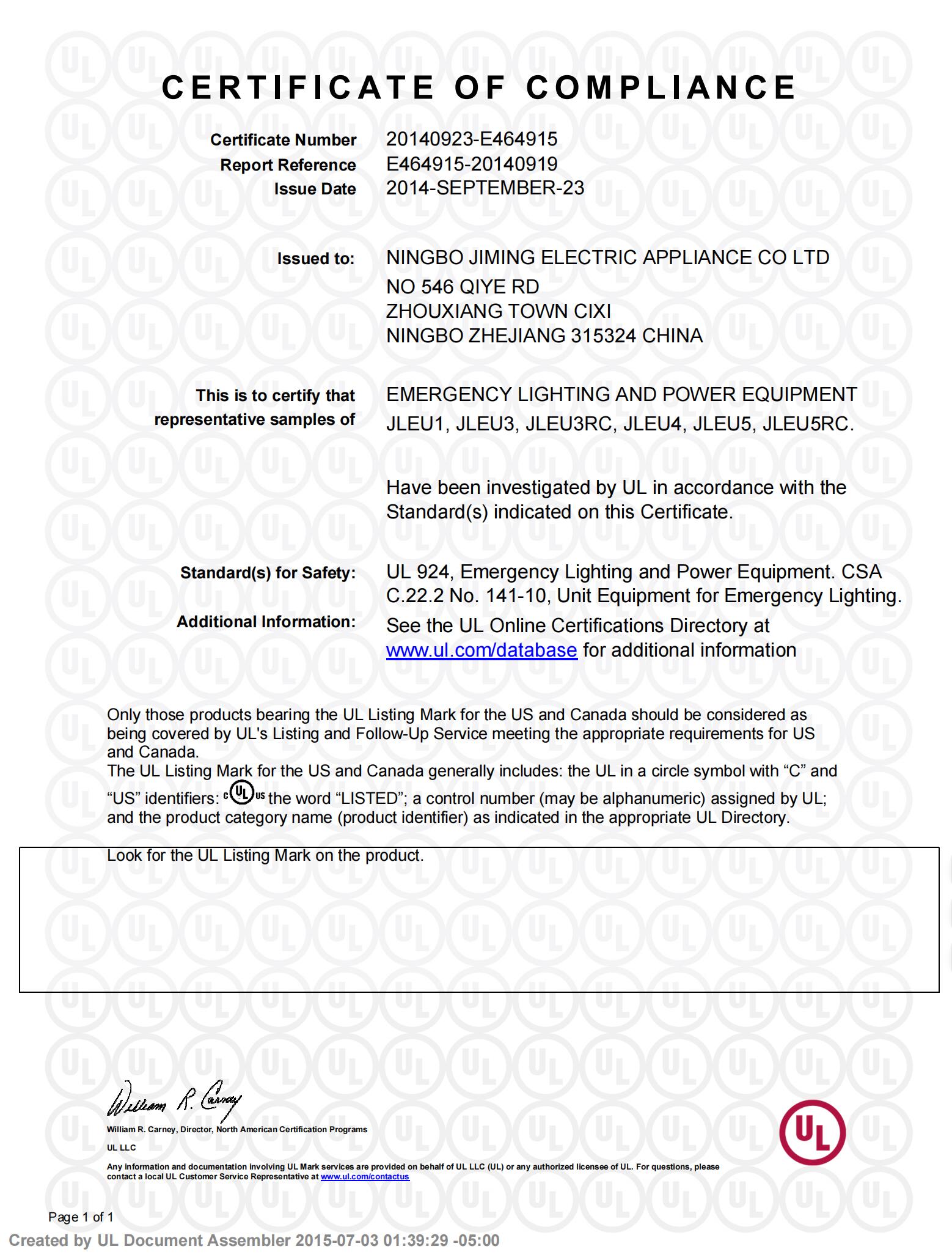
UL certificate of compliance for the emergency light series, issued by UL LLC under UL 924. Image: JIMING.
| Brief field | What to write | Why it changes the quotation |
|---|---|---|
| Environment | Below grade or open deck, condensation or drip, washdown, heated or unheated, exhaust film | Defines the location designation to be confirmed and the housing construction the supplier should quote |
| Supply voltage | The value at each circuit from the panel schedule, plus switched or unswitched | Determines input configuration; input voltage is also an OEM/ODM customization parameter |
| Mounting | Surface material, new or existing box, box type, height, approach direction | Determines bracket and housing, aiming, and whether the face reads from the approach |
| Signage configuration | Single or double face, required letter height, viewing distance | Determines which exit-sign body is quoted and how many faces are manufactured |
| Runtime and testing | Required minimum runtime and who performs periodic testing | Influences battery selection, access design and the maintenance routine |
| Documentation | Certificate numbers with scope and validity, model-level location designation, dated datasheet, mounting template | Supports submittal approval and prevents a post-award document chase |
| Commercial variables | Position count, customization, target ship window | MOQ 200 PCS, lead time 30–45 days; fixes packaging, logo and input configuration at RFQ stage |
Step-by-step: from egress survey to a quotable RFQ
- Walk the egress path and mark exposure classes. Number each position on the drawing and tag it with a short physical description: condensation, drip, washdown, exhaust film, unheated. Positions that share a class can share a model; positions that do not, cannot.
- Record voltage per circuit from the panel schedule. Do not carry voltage forward from the previous project. Note switching status and any remote-head requirement in the same pass.
- Record the mounting reality at each position. Surface material, existing box type, height, approach direction and access method for testing. Photograph the boxes; the photograph resolves arguments later.
- State the runtime and testing regime. Fixed runtime requirements plus the local testing obligation determine battery selection and access design. Confirm that obligation with the authority rather than assuming a neighbouring jurisdiction's rule applies.
- Build the documentation request. For each model in the quotation: certificate numbers with scope and validity, model-level location designation, dated datasheet, and a dimension drawing or mounting template.
- Quote by category, not by part number alone. JIMING's stated product lines include UL LED emergency and security lighting, UL exit signs, emergency battery packs and emergency ballasts, and its company material also refers to bulkhead emergency lights. A brief can therefore be matched across combo exit/emergency units, twin-head units and bulkhead styles according to exposure class rather than to a favourite part number.
- Lock commercial variables with the technical ones. Customization covers battery type, housing color, input voltage, logo and packaging; the minimum order quantity is 200 PCS; production lead time is 30–45 days. Fixing these at RFQ stage stops a technically correct quotation from becoming commercially unworkable.
Three project patterns where the brief changes the answer
The following are conditional configurations that show how the brief reshapes a request. They are not documented project outcomes.
Below-grade parkade with stair-door egress
Two fixture roles exist in one brief: signage at the stair door and path lighting on the deck. Separating them matters because the door unit's face configuration follows the approach direction while the deck units inherit the condensation exposure. Because the roles are separated at brief stage, the supplier can quote two configurations instead of one compromise, and the buyer can compare them line by line.
Open deck in a 220–240V market
Where the supply is 220–240V and the deck is open to weather or washed periodically, voltage and exposure dominate the request. The brief should state the supply, the cleaning method and the mounting height. Because input voltage is a customization parameter, the useful question is which configuration is offered, not whether the category fits — and the nameplate plus the model-level designation should come back in the same reply.
Occupied retrofit
In a retrofit the existing boxes and the access method constrain the answer more than the housing style. Photograph the boxes, note their type, and state whether the face can be single or must be double. Because the site stays in use, the ship window matters as much as the specification: a 30–45 day production lead time should be planned against the shutdown calendar rather than discovered after approval.
What JIMING publishes as product-level evidence
Ningbo JIMING Electric Appliance Co., Ltd. states that it was established in 1967 and has specialised in emergency lighting since then. Company material describes two company-owned facilities — a 70,000 m² plant in Ningbo, China and a 38,000 m² plant in Haiphong, Vietnam — with annual output of 5,000,000 sets, 96% of it exported, 1,000+ employees and a 50+ engineer R&D team. Monthly capacity is stated as 400,000 sets, quality control as 100% testing, and the quality system as ISO 9001 certified since 1998.
| Attribute | JLEU5-UL | JLEU6 |
|---|---|---|
| Configuration | Twin-head LED emergency light | Dual-head emergency light |
| Input voltage | 120V/277VAC | 120V–277VAC |
| Battery | 3.6V 1000mAh nickel-cadmium | 6V 4Ah lead-acid |
| Stated minimum emergency operation | 90 minutes | 90 minutes |
| Mounting | Not stated in the product listing | Listed as suitable for wall mount applications |
| Output designation | Not stated in the product listing | 600 lm product designation |
Company-reported case material describes a long-term OEM/ODM partnership with an internationally recognized brand for the North American retail market, running five years, in which the engineering team collaborated with the customer on new product development and supply remained stable and compliant with UL and CSA standards. The case indicates the shape of a partnership programme; it is company-reported and is not an independent performance record.
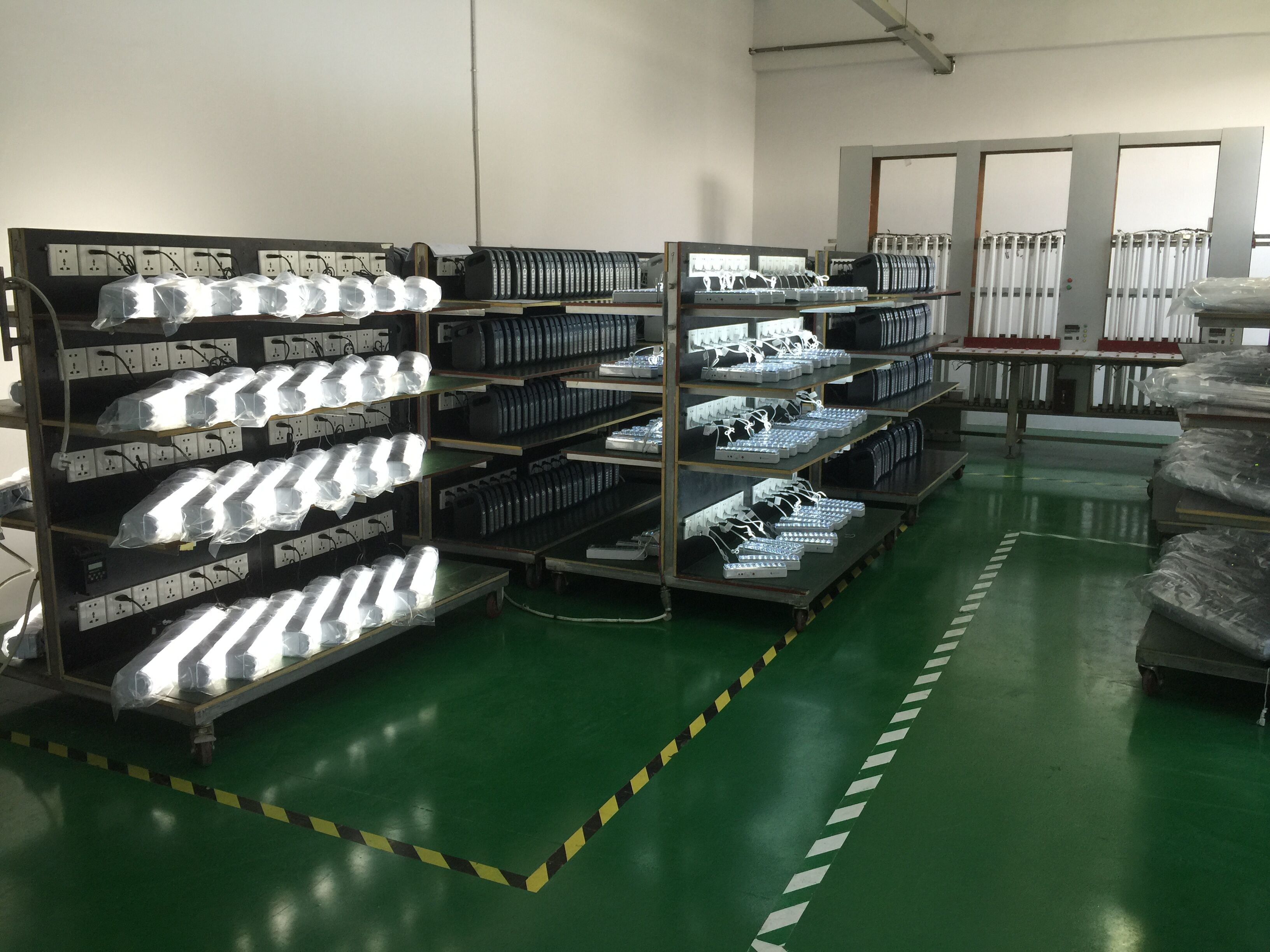
Product quality inspection: aging test of emergency lighting units. Image: JIMING.
What the published evidence does not establish
- Model-level ingress protection values or damp/wet location designations are not published in the material summarised here, so they must be requested per model.
- No photometric files, independent runtime test reports or battery cycle data are included; the listed runtime figures are stated minimums from company product listings.
- No pricing is published. MOQ, lead time and delivery terms are documented, but unit pricing requires a project-specific quotation.
- The UL certificate covers a product series; the UL 924 edition and effective status should be confirmed with UL directly, and the authority having jurisdiction determines adoption.
- The Minnesota and Kansas guidance cited above is jurisdiction-specific and cannot be generalised to other states or countries.
The practical use of published data is to screen suppliers and to structure questions. Approval should rest on the documents the supplier returns against the brief.
Frequently asked questions
Does a UL 924 certificate confirm that a fixture suits a damp parking area?
No. It confirms the equipment class. JIMING's UL certificate 20140923-E464915, issued by UL LLC on 23 September 2014 and valid to 23 September 2034 under standard UL 924, carries the scope UL Emergency Light Series. UL Standards & Engagement describes the standard as covering emergency lighting and power equipment, including exit signs and emergency luminaires, for connection to branch circuits of 600 volts or less. Suitability for a particular deck is a separate, model-level attribute: ask for the published location designation for the exact model, and have the authority having jurisdiction confirm which code edition applies.
How do we confirm that a fixture suits a damp parking location?
Put the exposure in writing and require a written answer at model level. The brief should state whether the area is below grade, whether condensation or drip reaches the fixture, whether cleaning involves water, and whether the space is heated; the supplier should return the published location designation or ingress rating for the exact model together with the dated datasheet revision. A certificate for a product family does not answer this question, and a verbal confirmation does not survive submittal review.
What voltage should a parking egress brief specify?
The voltage actually present at each circuit. JIMING's published listings show 120V/277VAC for the JLEU5-UL twin-head unit and 120V–277VAC for the JLEU6 dual-head unit, and input voltage is one of the customization parameters available on OEM and ODM orders alongside battery type, housing color, logo and packaging. For a 220–240V site, confirm the offered configuration and nameplate in writing rather than assuming a model number carries the same input range in every market. UL 924 scope is described for branch circuits of 600 volts or less, so the project requirement is what narrows the selection.
What are the minimum order quantity and commercial terms?
JIMING's stated minimum order quantity is 200 PCS. Delivery terms available are FOB, CIF, EXW and DDP; acceptance criteria include pre-shipment inspection with third-party inspection accepted; payment terms are TT. Production lead time is 30–45 days and monthly capacity is stated as 400,000 sets.
How should a sample be validated before a volume order?
Validate against the brief rather than against a catalogue photograph: compare the nameplate with the stated supply voltage, confirm the mounting template fits the actual box, confirm the face configuration and letter height read from the approach direction, and confirm the stated minimum 90-minute runtime on the model documentation. Kansas Fire Marshal guidance describes battery-powered emergency lights as relatively inexpensive, reliable, readily available off the shelf and easy to install, and refers to tested and listed units — which is why the listing and the model documentation, not the sample price, should decide approval.
What lead time and capacity should we plan for?
JIMING states a 30–45 day production lead time and a monthly capacity of 400,000 sets, with annual output of 5,000,000 sets across a 70,000 m² Ningbo plant and a 38,000 m² Vietnam plant. The practical next step is to send the four-part brief — scenario, voltage, mounting and documentation requirement — with the position count and target ship window, so that the quotation and the sample request come back on the same assumptions. Send it to inquiry-sgzt@ijiming.com or info@jiming.net, or call and message on +86-135-6655-7272.
Conclusion
A damp parking egress gap closes in the brief, not on site. Once the exposure, the supply voltage, the mounting reality and the document set are written down, most of the ambiguity that produces a rejected submittal disappears, and the supplier is answering a specification instead of a category.
The two habits that carry the most weight are the cheapest to adopt: describe the environment in physical terms rather than by room name, and ask for the model-level document rather than the family certificate. Both scale across a whole parkade, and both give the buyer a defensible record if the installation is questioned later.
Next step: send your position list, supply voltage and mounting details with a target ship window to request a sample or a project quotation.
Email: inquiry-sgzt@ijiming.com or info@jiming.net | Phone / WeChat / WhatsApp: +86-135-6655-7272 | www.ijiming.com
Ningbo JIMING Electric Appliance Co., Ltd., No.546, Qiye Road, Zhouxiang Town, Cixi City, Ningbo, China.
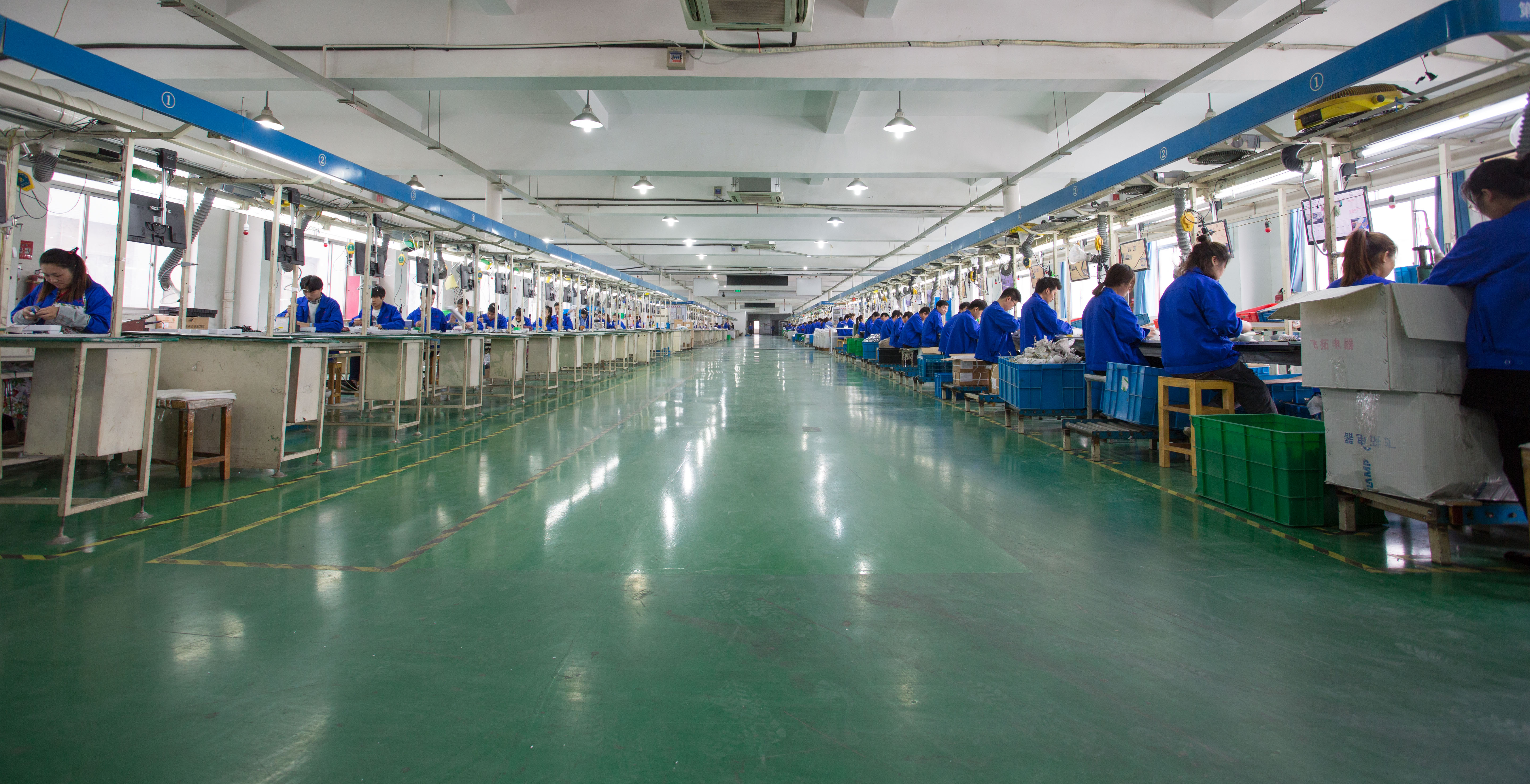
Final assembly workshop for OEM and ODM emergency lighting orders. Image: JIMING.
Have Questions or Need More Details?
Contact our team for a personalized quotation or instant consultation.
Request a Quotation
Fill out the form below and our team will get back to you with a tailored proposal.
WhatsApp Direct Chat
Prefer to chat in real-time? Message us on WhatsApp for instant assistance & quick answers.
- Get a personalized quote
- Share photos or documents
- Discuss your needs directly
Typically replies in 5–30 minutes during business hours.