
Dual Head vs. Bulkhead vs. Combo Emergency Lights Compared
Dual Head vs. Bulkhead vs. Combo Emergency Lights Compared
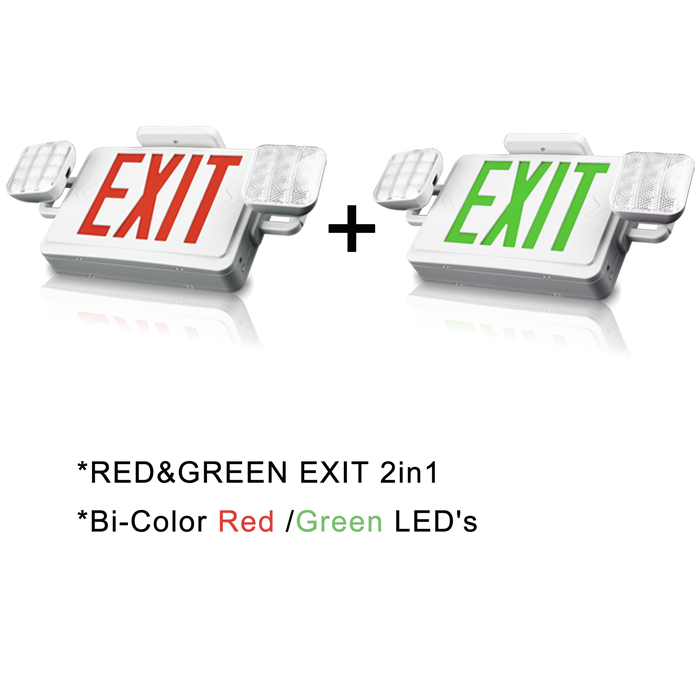
Choosing an emergency light type is a decision about three variables rather than brand preference: where the fixture mounts, what environment it has to survive, and what the local code requires it to do during a power failure. A dual head emergency light delivers directional illumination down an egress path from a wall or ceiling position. An emergency exit sign combo combines the exit legend and two integral LED heads in one housing, so a single junction box performs both functions. A bulkhead emergency light is a sealed, surface-mounted luminaire built for wet, dusty or wash-down-adjacent spaces.
Because the three families overlap in appearance but not in application, the wrong choice usually surfaces at inspection or in the first maintenance cycle rather than at the quotation stage. This guide compares the categories using published model data - the JLEU9 dual head unit, the JLEC2BCW exit sign combo and the LE518 bulkhead - and lays out the selection criteria that matter for commercial, industrial and multi-family projects in North America, Europe and the Middle East.
Why the Wrong Emergency Light Type Gets Specified
Most emergency lighting problems at the design stage are category errors rather than component errors, and three patterns repeat.
- Inherited specification. A project team reuses the fixture schedule from an earlier building without re-checking ceiling height, mounting surface or egress layout. Dual head units that worked in a hotel corridor get carried into a parking structure, where the enclosure rating - not the lumen output - becomes the limiting factor.
- Missing exit marking. Area illumination and exit marking are separate code functions. A corridor full of dual head emergency lights without a marked exit path can still fail an inspection, because egress depends on continuous exit identification as well as illumination.
- Over-specification in the opposite direction. Buying two devices - a standalone exit sign plus a separate emergency light - where one combo unit at the same junction box would satisfy both functions with fewer boxes, fewer connections and less battery maintenance.
For buyers, the cost of these mistakes is rework: new mounting hardware, re-inspection and a longer commissioning window. For a supplier, it is the more difficult problem of quoting the wrong platform before the environment and voltage are confirmed.
What Is Driving the Category Mix in 2025-2026
Emergency lighting sits in a structurally stable part of the lighting market. Grand View Research valued the global emergency lighting market at USD 7.82 billion in 2025 and projected it to reach USD 12.4 billion by 2033, a CAGR of 6.2 percent. North America accounted for a 37.4 percent revenue share in 2025, which the same analysis attributes to strict safety regulation rather than construction volume alone.
Two regulatory and technical currents shape which product family buyers specify:
- UL 924 requires emergency lighting and exit signs to provide at least 90 minutes of illumination during a power failure (UL Solutions).
- In 2022, UL 924 was updated to require active and continuous detection of normal power, moving away from passive detection devices.
The second point matters for product-family selection because it pushes more functionality into the fixture's control circuit, whether that fixture is a dual head unit, a combo or a bulkhead.
On the technology side, LED technology is expected to hold 51.28 percent of the global emergency lighting market by 2026 (Fortune Business Insights), which is why nearly every current specification in this category - including all three models discussed below - is LED based. Supply-side scale is equally relevant: China exported USD 31.4 billion in light fixtures in 2024, with the United States (USD 4.08 billion) and Germany (USD 1.91 billion) as leading destinations (OEC). Buyers evaluating an emergency light supplier are therefore choosing within a mature, export-intensive manufacturing base rather than a niche one.
Dual Head Emergency Lights: Directional Area Illumination
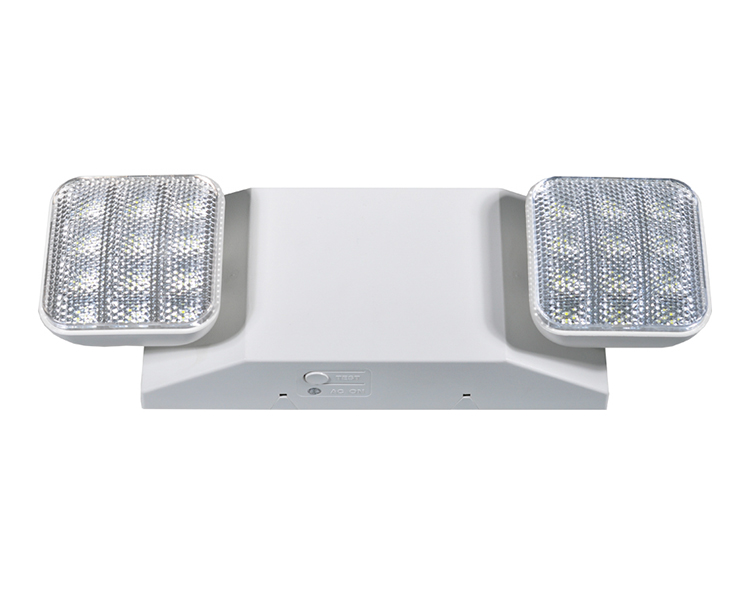
A dual head emergency light is a compact, surface-mounted unit with two adjustable lamp heads aimed along the egress path. It does not carry an exit legend - its job is illumination, not marking.
The JLEU9 is a representative example of the category. It is classified as a UL/cUL listed twin head LED emergency light. Its housing is injection-molded thermoplastic ABS with a UL 94V-0 flame rating, and it is suitable for wall mount applications using a universal J-box mounting pattern. It operates on 120/277VAC dual voltage and uses two heads of 12 ultra-bright 2835 SMT LEDs each in emergency mode. The built-in battery is 3.6V 1000mAh nickel cadmium, rated for a minimum of 90 minutes of emergency operation, with a maximum of 24 hours for full recharge. A test switch and charge indicator are fitted, and the unit is listed for indoor damp locations between 0 degrees C and 40 degrees C.
Where the dual head form factor is needed in a wet location rather than a damp one, the category does not stop at the damp-listed version. The JLEU5WP is a wet location LED emergency light with the same ABS UL 94V-0 housing approach, suitable for both wall and ceiling mount applications. It runs on 120/277VAC, uses two heads of 12 ultra-bright 2835 0.5W LEDs providing more than 400 lumens of emergency output, and carries a larger 3.6V 2000mAh nickel cadmium battery with the same 90-minute minimum runtime. This model is listed for indoor wet locations from 0 degrees C to 40 degrees C.
The dual head decision rule is short: choose this family when the egress path needs directional light and the exit legend is already handled elsewhere - and confirm whether the mounting location is damp or wet before locking the model number.
Emergency Exit Sign Combos: Marking and Area Light in One Box
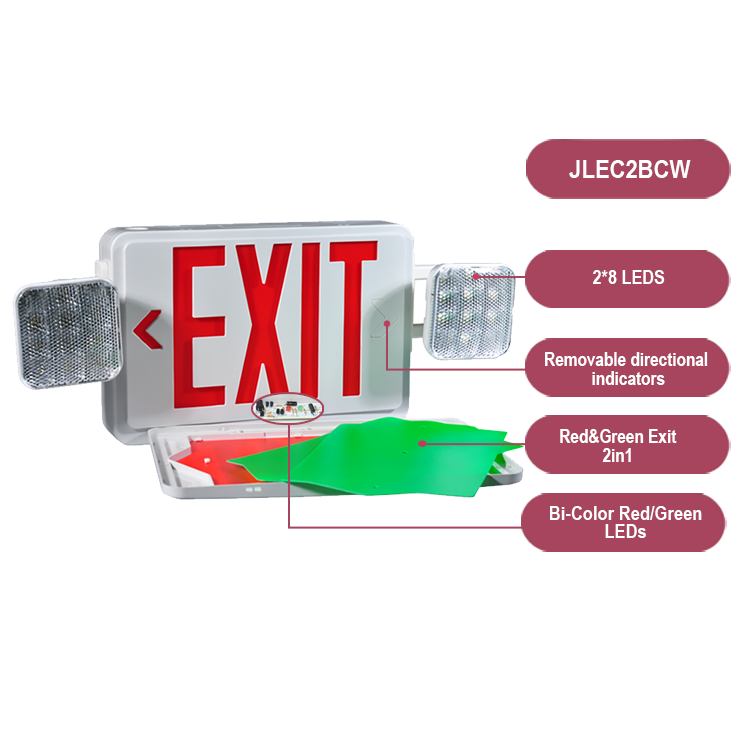
An emergency exit sign combo places the exit legend and two integral LED heads in a single housing. It is the most efficient choice where a corridor, lobby or stairwell entry needs both a marked exit and local area illumination at the same point.
The JLEC2BCW is a bi-color LED combo emergency exit sign with LED heads. It uses an injection-molded thermoplastic ABS housing with a UL 94V-0 flame rating and 6-inch letters with a 3/4-inch stroke in RED/GREEN two-color configuration; a SALIDA legend is also available. The unit can be supplied single or double face with removable directional indicators, and it mounts on a universal J-box pattern. Electrical characteristics match the dual head family: 120/277VAC dual voltage operation and two heads of 8 ultra-bright 2835 SMT LEDs each. The battery is a 3.6V 1200mAh nickel-metal hydride pack rated for a minimum of 90 minutes of emergency operation, with a maximum 24-hour recharge time. A test switch and charge indicator are included, and the fixture is listed for indoor damp locations from 0 degrees C to 40 degrees C.
Two structural details separate a combo from a dual head unit in practice. First, the legend is fixed at the factory or specified as a legend kit, so the combo must be ordered with the correct wording and face configuration before the shipment leaves. Second, the heads on a combo are usually lower in output than those on a dedicated dual head unit, because the housing must also carry the sign face.
For projects where area lighting is already covered by another listed fixture, a standalone aluminum exit sign - such as the JREEL2RM, a double-sided unit with 6-inch acrylic panels, removable directional indicators, 120-277VAC operation, a 4.8V 500mAh nickel-metal hydride battery and a 90-minute runtime - avoids paying for heads the room does not need. The operational saving is small; the specification clarity is not.
Bulkhead Emergency Lights: Sealed Light for Hard Environments
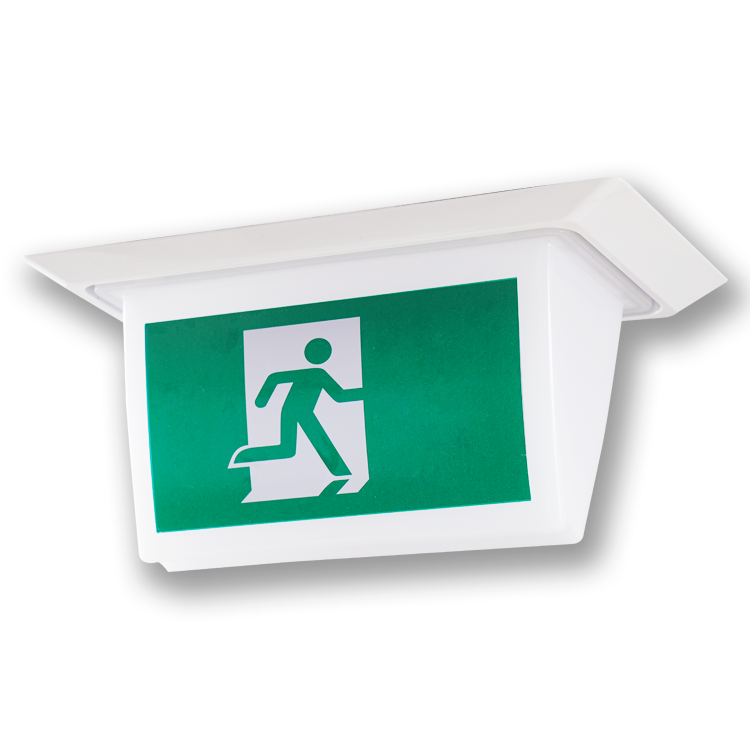
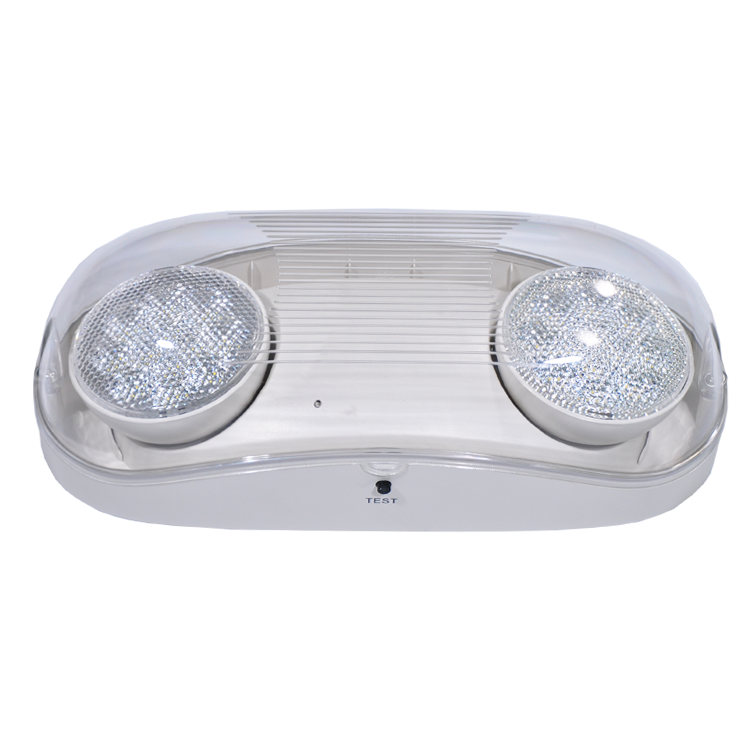
A bulkhead emergency light is a sealed, surface-mounted luminaire that trades directional aiming for environmental protection. The category is normally specified for parking structures, service corridors, loading areas, plant rooms and similar spaces where moisture, dust, impact or cleaning routines rule out open diffusers.
The LE518 illustrates how the category differs from the two above. It is a slim-type bulkhead emergency light with a clear polycarbonate diffuser and ABS housing - a materially different ingress design from the ABS-only housings used on the JLEU9 and JLEC2BCW. It uses 20 LEDs for a 200-lumen output at 6000-7000K, with an input power of AC 5W / DC 1W and an output power of 1.7W. Its operating voltage is 220-240V at 50-60Hz, not the 120/277VAC platform used by the North American models. The battery is a 3.2V 2000mAh LiFePO4 pack, charging in a maximum of 24 hours and discharging for 3 hours. Maximum charge current is 150mA and maximum discharge current is 550mA. The fixture supports both maintained and non-maintained modes, carries an IP65 rating, and can be converted into an edge-lit exit sign using accessories, with an optional multi-directional sticker legend kit.
The runtime figure is the headline difference. Where the dual head and combo models provide the 90-minute minimum associated with UL 924, the LE518's published discharge time is 3 hours. For buildings that specify extended-duration egress lighting - or that need one sealed device to serve as an area light and, with accessories, as an edge-lit exit marker - that changes the fixture count.
One scope note: recessed and surface emergency downlights such as the DLB300, which uses a 3.2V 4000mAh LiFePO4 battery, a 3-hour discharge time and interchangeable lenses, answer a different architectural brief - embedded ceiling mounting - and sit outside this three-way comparison.
Battery Chemistry: What Ni-Cd, Ni-MH and LiFePO4 Mean for Procurement
Battery selection is the specification line most often copied without review, yet it drives replacement intervals, disposal obligations and usable runtime in hot or cold locations.
Nickel cadmium (Ni-Cd). The JLEU9 uses a 3.6V 1000mAh Ni-Cd pack and the wet location JLEU5WP uses a 3.6V 2000mAh Ni-Cd pack. Ni-Cd is generally regarded in the industry as durable across a wide temperature range with a long service life, and it is a familiar, replaceable item for maintenance teams working on North American dual head emergency lights.
Nickel-metal hydride (Ni-MH). The JLEC2BCW combo uses a 3.6V 1200mAh Ni-MH pack with a minimum 90-minute runtime. Ni-MH generally offers higher capacity than Ni-Cd in a comparable envelope without cadmium, which is why combo and exit sign platforms frequently adopt it.
Lithium iron phosphate (LiFePO4). The LE518 bulkhead uses a 3.2V 2000mAh LiFePO4 pack with a published 3-hour discharge time and a maximum 24-hour charge. LiFePO4 is generally favored where longer discharge duration and longer cycle life are required.
For procurement, the practical test is not which chemistry sounds newer. It is whether the datasheet states capacity, duration, charge time and charge/discharge current limits, and whether a replacement battery is available in the same form factor. All three models above publish those values. The JLEU9 and JLEC2BCW also publish a test switch and charge indicator, while the LE518 publishes maintained and non-maintained operating modes.
Comparison Table: Dual Head vs. Combo vs. Bulkhead
| Attribute | Dual Head (JLEU9) | Exit Sign Combo (JLEC2BCW) | Bulkhead (LE518) |
|---|---|---|---|
| Primary function | Directional area illumination along the egress path | Exit marking plus area illumination from one housing | Sealed area illumination; convertible to an edge-lit exit sign with accessories |
| Mounting | Wall mount, universal J-box pattern | Universal J-box pattern; single or double face | Surface-mounted slim bulkhead |
| Housing | Injection-molded thermoplastic ABS, UL 94V-0 flame rating | Injection-molded thermoplastic ABS, UL 94V-0 flame rating | Clear polycarbonate diffuser and ABS housing |
| Voltage platform | 120/277VAC dual voltage | 120/277VAC dual voltage | 220-240V 50-60Hz |
| Light source | 2 x 12 pcs ultra-bright 2835 SMT LED heads | 2 x 8 pcs ultra-bright 2835 SMT LED heads plus LED sign face | 20 LEDs, 200 lm, 6000-7000K, output power 1.7W |
| Battery | 3.6V 1000mAh Ni-Cd | 3.6V 1200mAh Ni-MH | 3.2V 2000mAh LiFePO4 |
| Emergency duration | Minimum 90 minutes | Minimum 90 minutes | 3 hours discharge |
| Recharge time | Maximum 24 hours | Maximum 24 hours | Maximum 24 hours |
| Location listing | Indoor damp location listed | Indoor damp location listed | IP65 |
| Operating temperature | 0 degrees C to 40 degrees C | 0 degrees C to 40 degrees C | Not stated in the published specification |
| Exit marking | None (illumination only) | 6-inch letters, 3/4-inch stroke, RED/GREEN bi-color, SALIDA available, removable directional indicators | Optional multi-directional sticker legend kit; edge-lit exit conversion via accessories |
| Certification coverage | UL certificate 20140923-E464915 (UL 924) issued by UL LLC, valid until 2034-09-23; FCC certificate ENB2504250012E00201C; CE certificate ENB2312180102E01101C; ISO 9001:2015 | UL certification applies to the Emergency Exit Sign Combo (product 1499); CE certification applies to the JLEC2BCW for the EU market | UL Emergency Light Series certification covers the Bulkhead emergency light (product 1500); CE certification applies to the LE518 for the EU market |
Values above are taken from the published specifications and certificate scopes of the named models. Listing coverage is model-specific and the voltage platform must be confirmed for each destination market before ordering.
Step-by-Step: How to Choose the Right Type
- Separate the two code functions. List the egress path illumination points and the exit marking points independently. If a marking point also needs local light, that is a combo position. If it only needs marking, a standalone exit sign is sufficient.
- Map the mounting geometry. Wall positions suit the JLEU9; wall or ceiling positions suit the JLEU5WP wet location dual head; combos sit on a universal J-box pattern near doorways and stair entrances.
- Confirm the environment. Damp indoor corridors accept damp-listed ABS housings. Wet, dusty or wash-down-adjacent areas require either a wet location listing (JLEU5WP) or an IP65 sealed housing (LE518).
- Match the electrical platform. 120/277VAC covers most North American installations; 220-240V 50-60Hz is the platform for the LE518 in EU-type supplies. A mismatch here invalidates the rest of the specification.
- Decide runtime and chemistry together. A 90-minute minimum is the baseline for the JLEU9 and JLEC2BCW; a 3-hour discharge is available on the LE518. Battery chemistry, replacement availability and disposal rules should be confirmed at the same time as duration.
- Verify listing scope and documentation. Ask the emergency light supplier to confirm that the certificate names the exact catalogue number, not just the product family.
- Validate commercially. Request samples of each candidate type, then confirm MOQ, lead time and origin documents before releasing the order.
Use Cases: Which Type Fits Which Space
Office, hotel and multi-family corridors. Dual head units mounted on corridor walls handle directional egress lighting, while combos positioned at stairwell doors and lobby exits remove the need for separate signs and lights at the same point.
Retail aisles and warehouse open areas. Combo units reduce device count along long runs, because marking and area light come from one housing and one battery.
Parking structures, loading docks, service corridors and plant rooms. The IP65 bulkhead handles moisture, dust and cleaning exposure, and its 3-hour discharge supports extended-duration briefs. Where a dual head form factor is required in an indoor wet area, the JLEU5WP covers that position.
Renovation projects with existing signage. Where exit legends are already installed and listed, adding dual head units or standalone exit signs avoids over-specifying combos into positions that do not need integrated heads.
Multi-market programmes. A single fixture schedule usually has to split by voltage platform: 120/277VAC models for North American jobs, 220-240V models such as the LE518 for EU-type supplies.
Compliance and Certification Checkpoints Before You Order
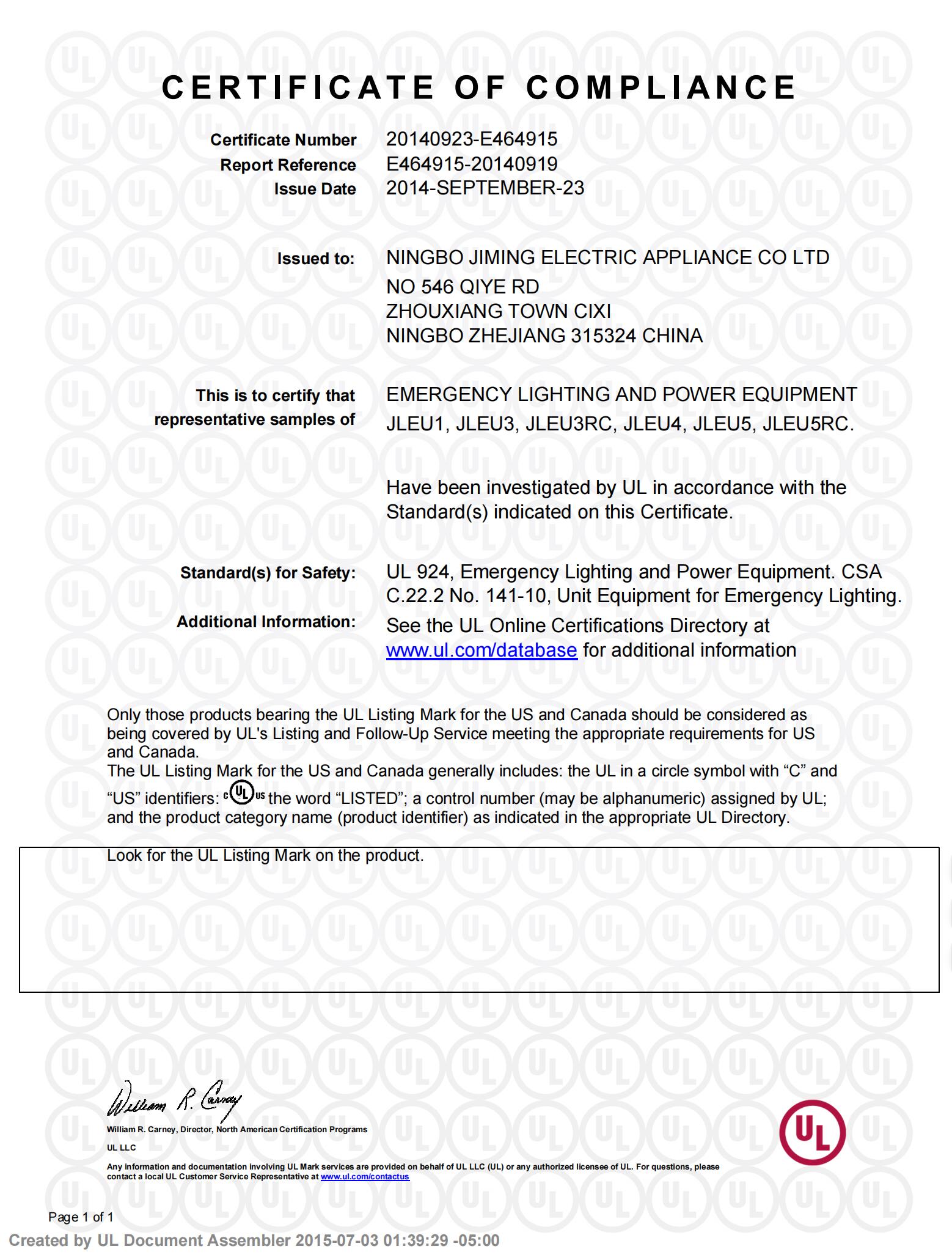
- 90-minute baseline. UL 924 requires at least 90 minutes of illumination during a power failure, and the 2022 update requires active and continuous detection of normal power.
- Model-level listing. Confirm that the certificate scope names the exact catalogue number. Across the models discussed here, UL certification for the Emergency Light Series is held under certificate 20140923-E464915 issued by UL LLC, valid until 2034-09-23 and compliant with UL 924; UL certification also applies to the Emergency Exit Sign Combo (product 1499); and the UL Emergency Light Series certification covers the Bulkhead emergency light (product 1500).
- Electromagnetic and safety compliance. The LED emergency light holds FCC certificate ENB2504250012E00201C issued by EMTEK (Ningbo) Co., Ltd. for the US market, compliant with FCC CFR Title 47, Part 15, Subpart B ANSI C63.4-2014. CE certificate ENB2312180102E01101C, issued by EMTEK (Ningbo) Co., Ltd. for the EU market, complies with EN IEC 55015:2019+A11:2020, EN IEC 61547:2023, EN IEC 61000-3-2:2019/A1:2021 and EN 61000-3-3:2013/A2:2021/AC:2022-01. CE certification also applies to the DLB300, LE518 and JLEC2BCW for the EU market.
- Factory-level quality system. JIMING holds ISO 9001:2015 certification under certificate number 00125Q33670R3M/3302 issued by CHINA QUALITY CERTIFICATION CENTRE, and has been certified to ISO 9001 since 1998. Production follows a test-every-unit protocol meeting global standards including UL, CSA, CE, NFPA, OSHA, FCC, DOE, CEC, NEC, IBC, NEMA, BSCI, SASO, REACH and RoHS compliance.
FAQ
Do dual head, combo and bulkhead emergency lights all satisfy UL 924?
UL 924 requires emergency lighting and exit signs to provide at least 90 minutes of illumination during a power failure, and the 2022 update added a requirement for active and continuous detection of normal power. The models discussed here publish a minimum 90-minute emergency operation for the JLEU9 and JLEC2BCW, and a 3-hour discharge time for the LE518. Listing remains model-specific: UL certification for the Emergency Light Series is held under certificate 20140923-E464915 issued by UL LLC, valid until 2034-09-23 and compliant with UL 924; the UL Emergency Light Series certification also covers the Bulkhead emergency light (product 1500); and UL certification applies to the Emergency Exit Sign Combo (product 1499). Before releasing a purchase order, confirm that the certificate scope names the exact catalogue number being ordered.
Can one emergency light supplier deliver all three types on the same programme?
JIMING manufactures across the three families. Its range covers dual head emergency lights (JLEU9 for damp locations and JLEU5WP for wet locations), exit sign combos (JLEC2BCW), bulkhead emergency lights (LE518), standalone exit signs, LED emergency drivers and emergency ballasts. Battery type, housing color, input voltage, logo and packaging can be customized under OEM/ODM arrangements. The 120/277VAC platform serves North American projects, while the LE518 operates on 220-240V 50-60Hz for EU-type supplies, so the voltage platform has to be fixed at the enquiry stage rather than after tooling begins.
What drives the price difference among dual head, combo and bulkhead units?
Four cost drivers dominate. First, device count: a combo replaces an exit sign plus a separate emergency light at the same junction box, reducing housing, wiring and battery count. Second, ingress design: a sealed IP65 bulkhead such as the LE518 requires a polycarbonate diffuser and sealing system that an indoor damp-listed ABS housing does not. Third, the battery pack: capacity and chemistry differ across the three models (3.6V 1000mAh Ni-Cd, 3.6V 1200mAh Ni-MH, 3.2V 2000mAh LiFePO4). Fourth, certification scope and order volume. JIMING structures OEM solutions across three cost-structure tiers (Value, Balanced, Premium) with a MOQ of 200 pcs, so buyers can align the cost structure with their market positioning.
How can a buyer validate a fixture type before committing to volume?
Request physical samples of the specific models under consideration - for example the JLEU9 dual head unit, the JLEC2BCW combo and the LE518 bulkhead - and check the three things a datasheet cannot confirm: whether the lamp heads cover the intended corridor geometry, whether the housing fits the mounting surface and J-box position, and whether the legend or directional indicators arrive in the configuration specified. JIMING maintains a test-every-unit protocol and holds ISO 9001:2015 certification under certificate number 00125Q33670R3M/3302 issued by CHINA QUALITY CERTIFICATION CENTRE, with ISO 9001 certification held since 1998.
What are the MOQ and lead time for a mixed-type emergency lighting order?
JIMING quotes a MOQ of 200 pcs and a lead time of 30-45 days, with a monthly capacity of 400,000 sets and an annual output of 5,000,000 sets. Production runs across two company-owned facilities: a 70,000 m2 factory in Ningbo, China and a 38,000 m2 factory in Haiphong, Vietnam, which supports Vietnam origin certificates and tariff flexibility for North American importers. The Vietnam facility currently operates three assembly lines at approximately 50 percent capacity, with infrastructure to scale to nine lines. To move a mixed dual head, combo and bulkhead programme forward, send your fixture schedule and target markets to inquiry-sgzt@ijiming.com or discuss requirements on WhatsApp at +86-135-6655-7272.
Conclusion
The three categories answer three different questions. Dual head emergency lights, such as the JLEU9 and its wet location variant the JLEU5WP, provide directional egress illumination where marking is handled separately. Combos, such as the JLEC2BCW, mark the exit and light the area around it from one junction box, cutting device count in corridors and stairwell entries. Bulkheads, such as the IP65-rated LE518, trade aiming flexibility for environmental protection and a 3-hour discharge time in parking structures, service areas and other hard environments.
The order of decisions matters more than the model number: fix the code function, confirm the mounting geometry, verify the environment rating and voltage platform, then select runtime and battery chemistry, and finally validate the listing scope and commercial terms. Buyers who sequence the decision this way rarely have to re-specify after the first inspection.

Next step. Share your fixture schedule, target market and voltage platform with the team at JIMING (Ningbo JIMING Electric Appliance Co., Ltd.), a manufacturer specializing in emergency lighting since 1967. Ask for samples of the model types under evaluation, or request a quotation against your annual volumes.
Email: inquiry-sgzt@ijiming.com | WhatsApp / WeChat: +86-135-6655-7272 | Website: ijiming.com
Have Questions or Need More Details?
Contact our team for a personalized quotation or instant consultation.
Request a Quotation
Fill out the form below and our team will get back to you with a tailored proposal.
WhatsApp Direct Chat
Prefer to chat in real-time? Message us on WhatsApp for instant assistance & quick answers.
- Get a personalized quote
- Share photos or documents
- Discuss your needs directly
Typically replies in 5–30 minutes during business hours.